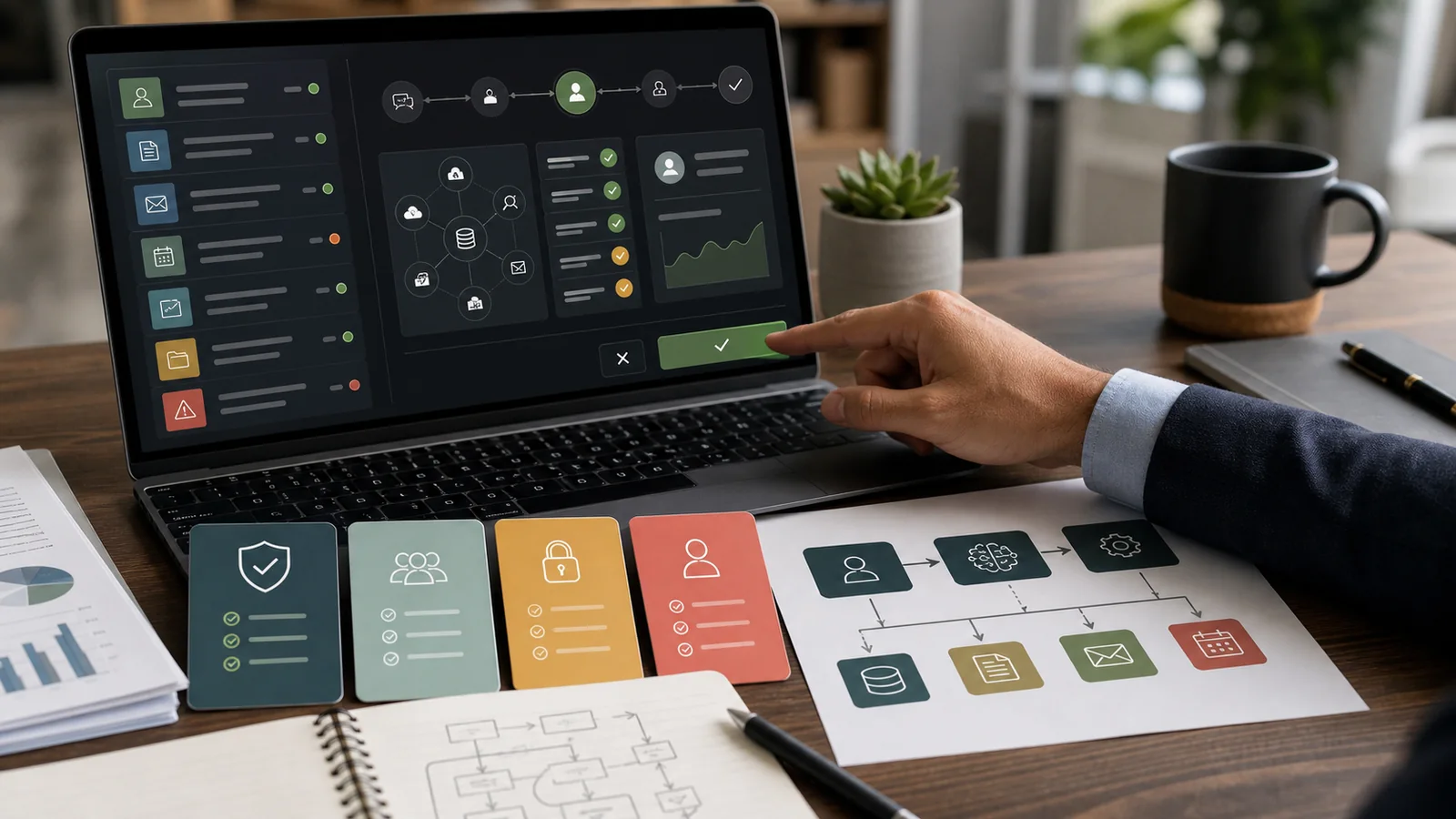
Agentic AI describes AI systems that can pursue a defined goal, use tools, preserve context, make intermediate decisions, and take controlled action rather than only answering a question.
A chatbot usually responds inside a conversation. An agentic AI system is designed to help move work forward: checking information, using approved tools, drafting outputs, routing tasks, escalating exceptions, or updating connected systems.
What makes an AI system agentic
- A clear goal or task boundary.
- Access to tools such as search, CRM, documents, forms, APIs, or workflow systems.
- Context or memory that helps the system continue work across steps.
- Rules for when to act, ask, escalate, or stop.
- Monitoring and audit trails so the business can govern what happened.
Business examples
Agentic AI can support service triage, quote preparation, document review, knowledge retrieval, internal helpdesk work, CRM follow-up, reporting support, and operations coordination.
The best use cases are not the flashiest. They are the repeatable workflows where context and action matter, but where the business still needs permissions, review points, and human oversight.
Builder platform or custom agent?
Some teams should start with an AI agents platform or no-code agent builder to test patterns quickly. Others need custom engineering because the workflow touches sensitive data, complex integrations, or production systems.
ExIQ helps organisations design and build autonomous AI agents that fit the operating environment rather than forcing the business into a demo pattern.
What a production agent needs around it
A production agent needs more than model access. It needs a task boundary, tool permissions, data rules, logging, human review, fallback paths, monitoring, and a named business owner. Without those pieces, the agent may be technically capable but operationally untrusted.
For example, a service follow-up agent might be allowed to read a CRM record, draft an email, create an internal task, and suggest a next action. It may not be allowed to send externally, change pricing, approve a refund, or update sensitive customer fields without human approval. That distinction is the operating model.
A practical sequence for introducing agents
The safest sequence is usually to start with read-only retrieval, then staff-facing summaries, then internal task drafting, then supervised tool use. External messages, system updates, commercial commitments, or customer-impacting actions should come later, after logs and reviewer feedback show the agent is reliable inside the narrow workflow.
This staged path matters because agentic systems can fail in ways that ordinary chatbots do not. A wrong answer is one problem. A wrong tool call, stale source, missing permission, duplicate record, or unsupported action can move work in the wrong direction unless the operating model catches it early.
The first agent pilot should produce evidence, not autonomy
A useful pilot should leave behind a permission matrix, approved-source list, failure catalogue, reviewer correction log, escalation examples, support owner, and a view of the manual work that actually reduced. If the pilot cannot produce those artefacts, the organisation does not yet know enough to expand authority.
The evidence should be reviewed by the people who will operate the agent after launch. Operations, risk, service, technology, data, and the workflow owner may each see a different failure mode. That review is what turns a clever demo into a candidate production pattern.
Where agentic AI is usually a poor fit
Agentic AI is a poor first choice when the process is unclear, the source data is unreliable, the task has no owner, the organisation cannot review the output, or the consequences of a wrong action are high and hard to reverse. In those cases, the better starting point may be workflow redesign, knowledge cleanup, reporting improvement, or a human-assist tool rather than an autonomous agent.
The safest first agent use cases usually involve bounded internal work: intake summaries, queue triage, missing information checks, supplier or customer follow-up drafts, knowledge retrieval, and task preparation. They give the business evidence before permissions expand.
How to measure an agent
- Task completion: did the agent finish the work it was designed to support?
- Escalation quality: did it hand off uncertain, sensitive, or high-risk work at the right point?
- Tool-call reliability: did connected systems return the expected information or action?
- Review burden: did people spend less time checking than they would have spent doing the task manually?
- User trust: do staff keep using the agent after the novelty period ends?
- Control evidence: are logs, approvals, exceptions, and incidents visible enough for governance review?